
2025 iGEM Gold Medal · FoCas DNA Origami Platform
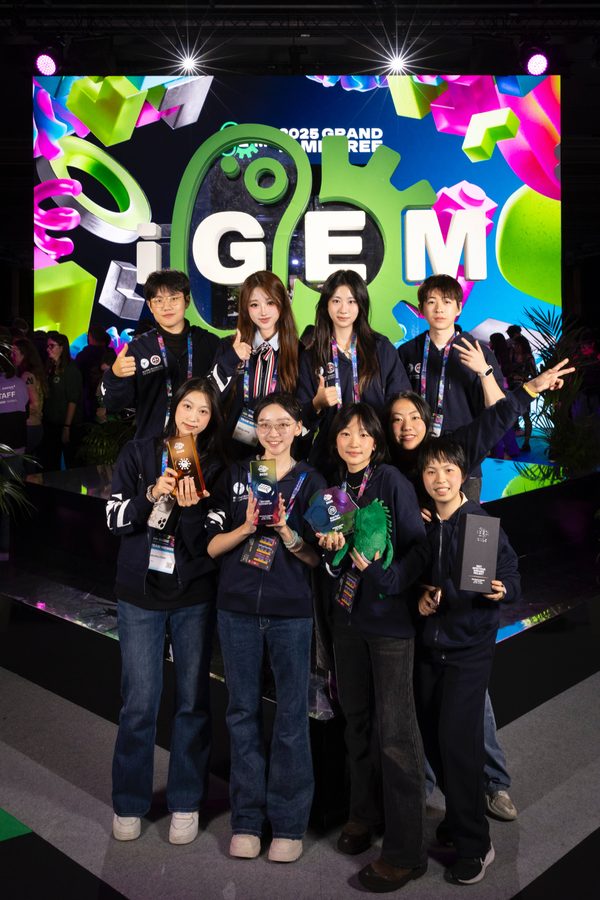
In the 2025 iGEM competition, I participated in iZJU-China's FoCas project, a synthetic biology platform designed to address antimicrobial resistance by combining a DNA origami delivery system with a CRISPR-Cas9 gene-editing module. The team won a Gold Medal and advanced as a finalist in the undergraduate track.
Awards
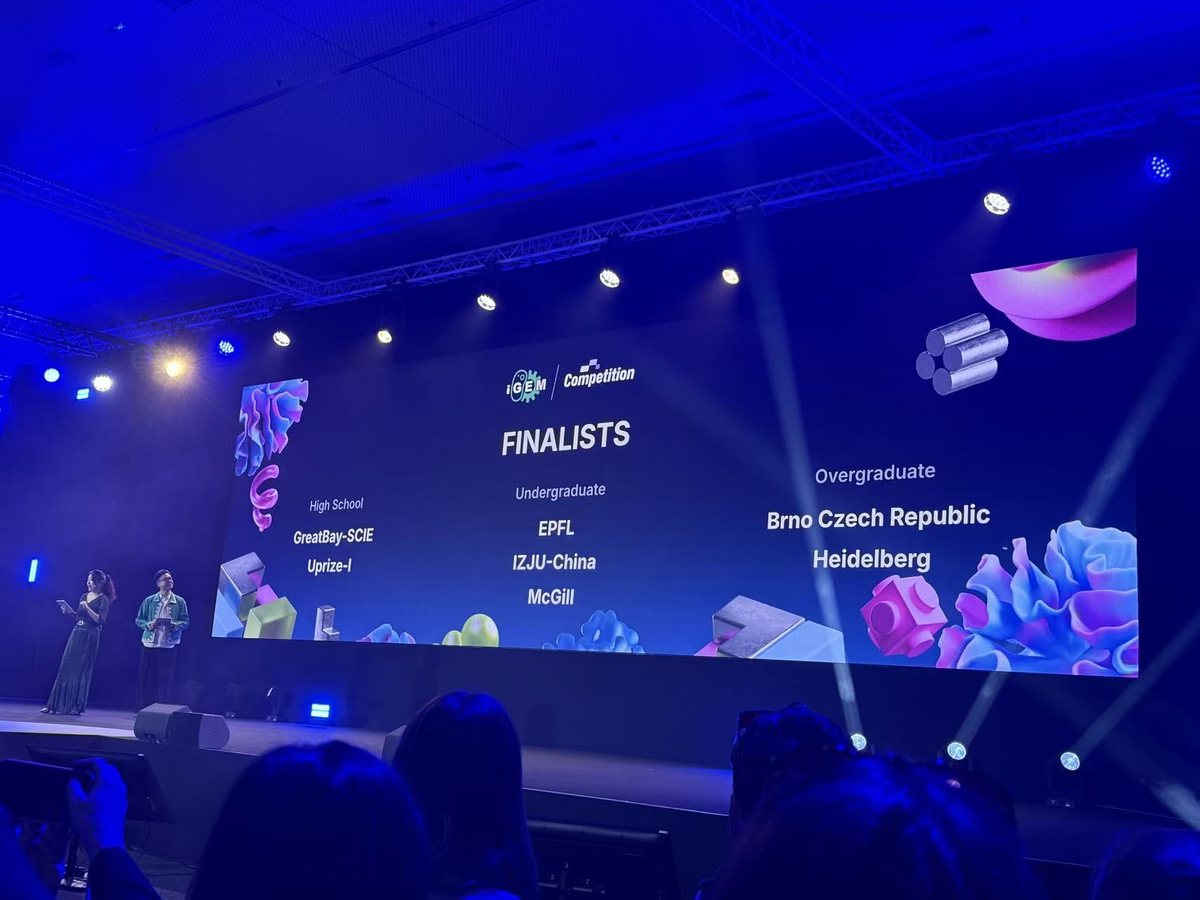
iZJU-China was listed among the undergraduate finalists at the 2025 iGEM Grand Jamboree.
Gold Medal and Finalist Recognition
The FoCas project received a Gold Medal, entered the undergraduate finalist group, and was recognized with project and part-collection awards. These results reflected both the project's technical design and the team's integrated work across modeling, wet lab, human practices, and presentation.
My contribution sat mainly in modeling, DNA origami analysis, and preparation for the Paris defense.
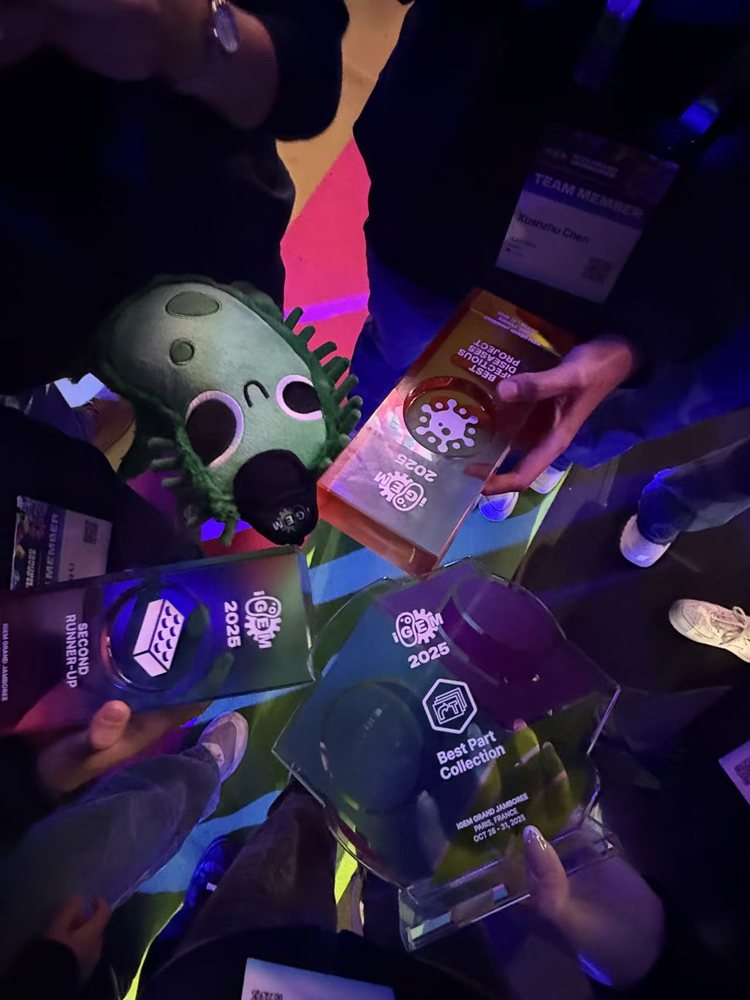
Awards and team memories from the 2025 iGEM Grand Jamboree in Paris.
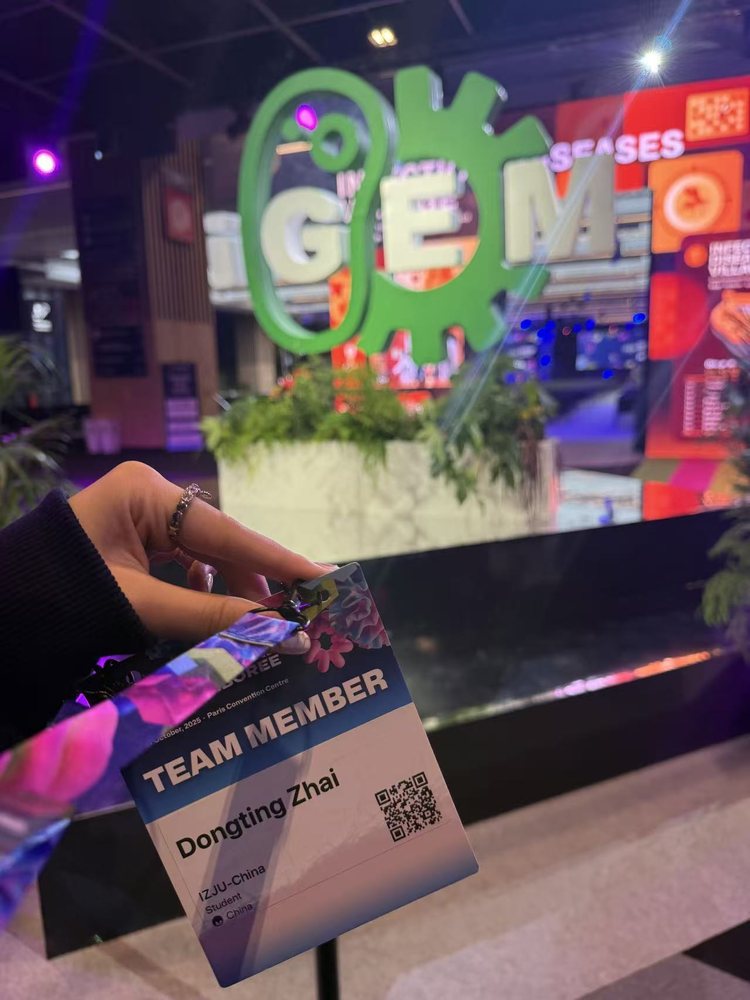
Team member badge at the Paris Convention Centre.
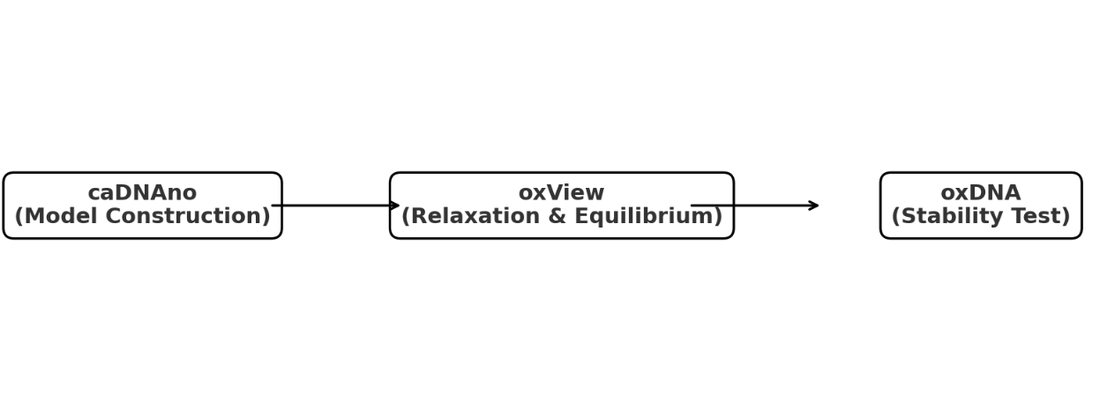
The modeling workflow moved from caDNAno construction to oxView relaxation and oxDNA stability testing.
Modeling Workflow
The dry-lab pipeline began with a rectangular DNA origami design based on the M13mp18 scaffold. I helped organize the computational workflow from caDNAno model construction, through oxView relaxation and equilibration, to downstream oxDNA simulation.
This workflow allowed the team to move beyond a static design and evaluate whether the DNA origami platform could remain geometrically and thermodynamically stable under coarse-grained simulation conditions.
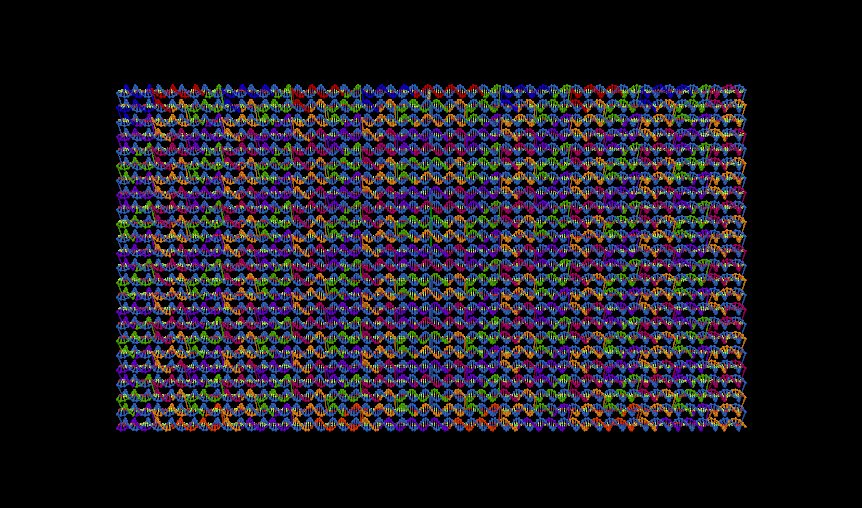
After staged relaxation and equilibration, the model showed a smoother rectangular geometry.
Structure Design and Optimization
In caDNAno, the square-lattice mode was used to construct a basic rectangular DNA origami platform, including scaffold routing and staple placement. The design was then imported into oxView for three-dimensional inspection and structural refinement.
The oxView process helped reduce local strain from dense loop regions and overstretched bonds. The equilibrated structure was exported as topology and coordinate files for oxDNA analysis.
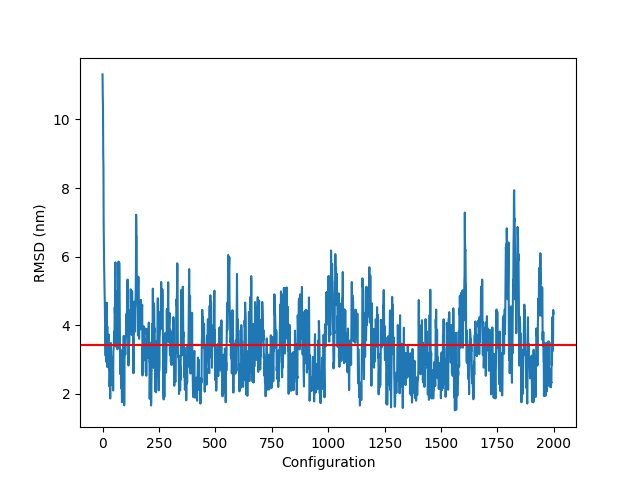
RMSD analysis indicated that the structure approached a stable mean conformation during simulation.
Stability Evaluation
In oxDNA, stability was assessed through RMSD/RMSF, distance, and energy analyses. The RMSD profile fluctuated around a mean baseline of approximately 3.5 nm, while most nucleotide regions showed low positional fluctuation in RMSF analysis.
Distance and energy profiles further supported the stability of the design: key nucleotide-pair distances remained narrowly distributed around 1.2-1.4 nm, and the energy per particle converged around -1.49 simulation units.
Selected Results
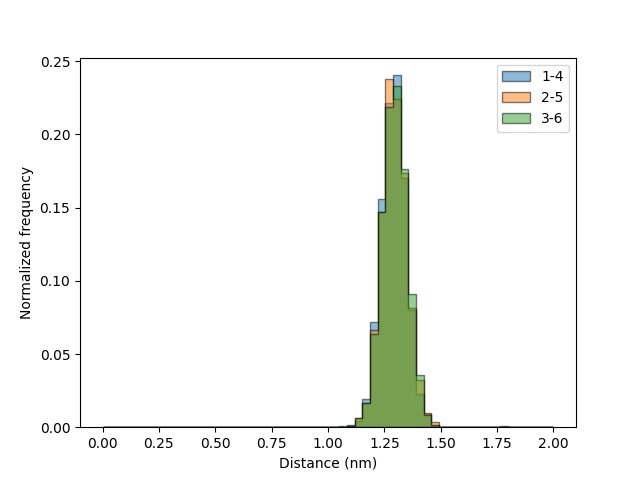
Distance histogram showing stable separations for selected nucleotide pairs.
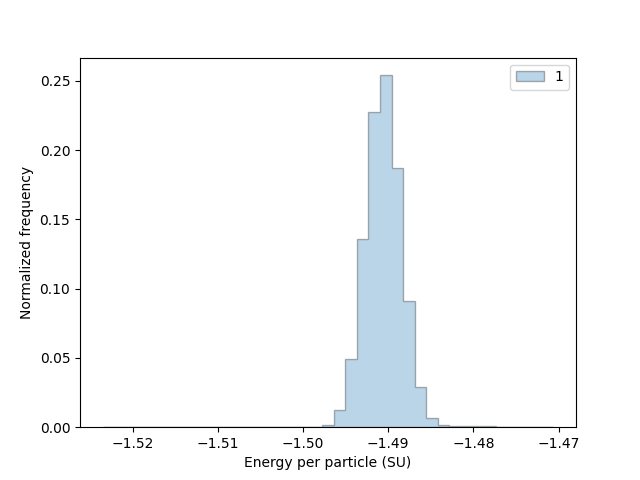
Energy trajectory showing convergence after initial relaxation.
Additional Modeling for the Paris Defense
Separately from the oxDNA stability workflow, I also helped prepare the modeling narrative used in the Paris defense. This part of the work asked how wound-related enzymes and reactive oxygen species might challenge the FoCas system, and whether the DNA origami shell could help protect the Cas9/sgRNA module.
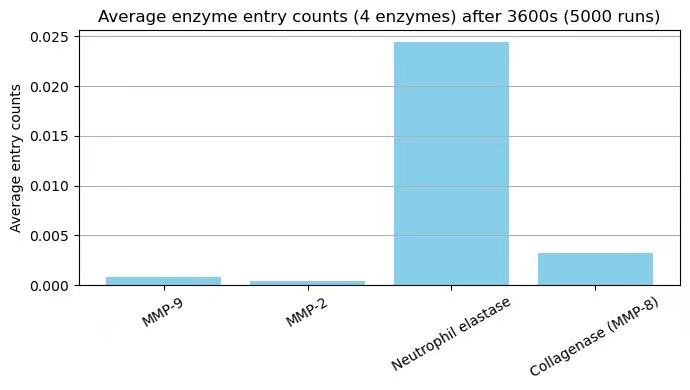
Estimated entry counts for wound-related enzymes under the pore-entry model.
Enzyme Entry and Cas9 Damage
The first defense model focused on enzymes related to Cas9 degradation. Enzyme arrivals were described as stochastic entry events, with pore passage estimated from enzyme size, diffusion, concentration, and a sigmoid-like selectivity term.
After entry, each enzyme contributed to a cumulative damage score. This helped frame the question of how often physiological enzymes might pass through the DNA nanotube pores and reduce Cas9 structural stability.
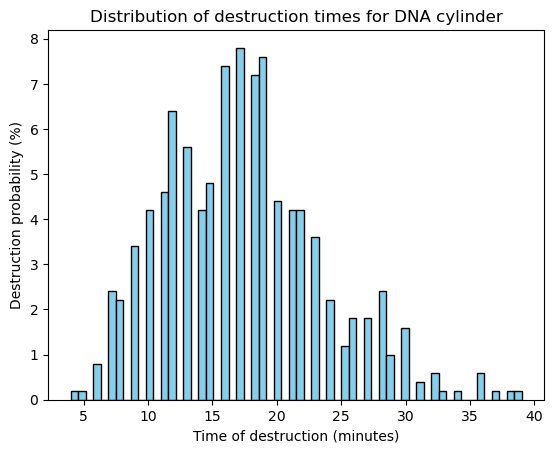
Monte Carlo simulation estimating the distribution of DNA cylinder destruction time.
DNA-Enzyme Cleavage Model
The second model treated the DNA origami cylinder itself as the target. Using the same stochastic logic, DNA-enzyme attack events were simulated over time to estimate whether the cylinder would remain intact or move toward structural destruction.
This separated the Cas9-protection question from the origami-degradation question: one model considered enzyme entry through pores, while this one considered cleavage damage accumulated on the DNA scaffold.
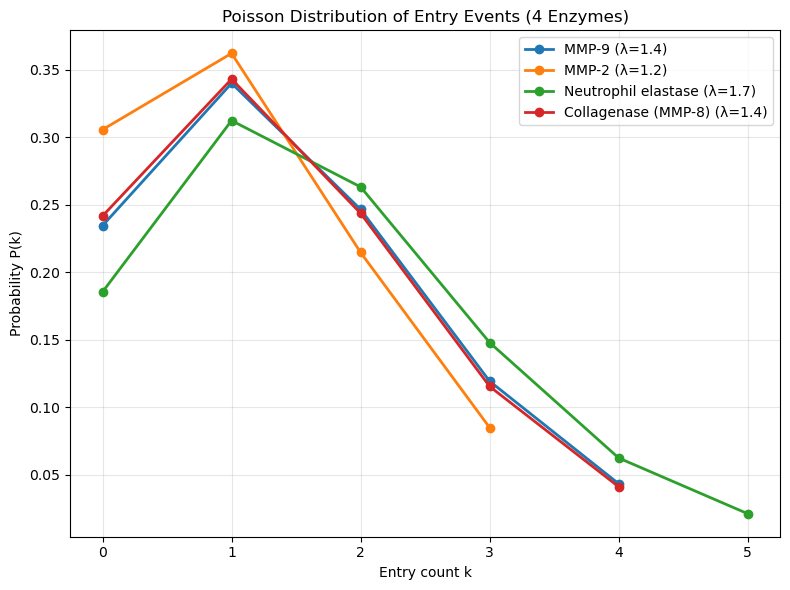
Poisson distributions used to compare enzyme entry-event probabilities.
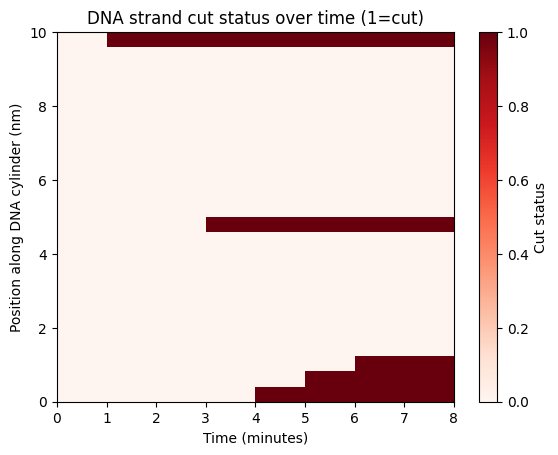
Cut-status heatmap describing strand-level damage progression during cleavage simulation.
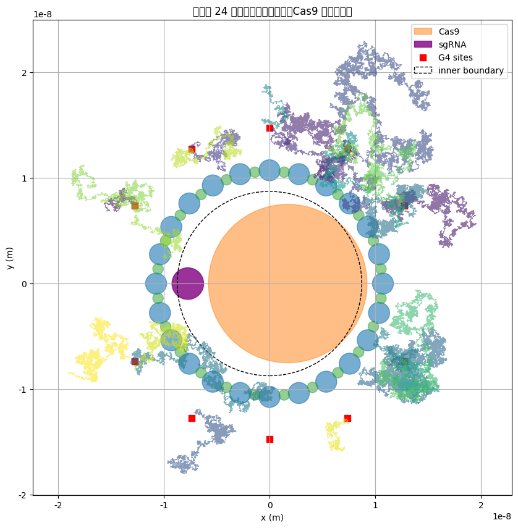
Brownian diffusion model for ROS movement around the Cas9-DNA origami complex.
ROS Diffusion and Protective Shell
The third model described ROS movement with a Brownian-motion-style diffusion simulation around a 24-helix DNA origami tube. Cas9/sgRNA positioning, G4/hemin catalytic sites, and collision events were used to discuss oxidative damage risk.
In the defense materials, this model supported the broader design claim that the DNA origami shell could act as a protective carrier, reducing direct ROS exposure to the Cas9/sgRNA module under wound-like biochemical conditions.
My Contributions
- Helped develop the DNA origami modeling pipeline from caDNAno design to oxView and oxDNA analysis.
- Assisted with structural inspection, relaxation, and simulation-oriented evaluation of the designed platform.
- Summarized stability evidence using RMSD/RMSF, distance distribution, and energy analysis.
- Assisted with enzyme-entry, DNA-cleavage, and ROS-diffusion modeling communication for the Paris presentation/defense.
- Helped connect nanostructure design assumptions with biological feasibility in the FoCas project narrative.
Methods and skills: DNA origami, caDNAno, oxView, oxDNA, computational modeling, coarse-grained simulation, molecular dynamics, Monte Carlo simulation, RMSD/RMSF analysis, distance analysis, energy analysis, scientific presentation.